You’re probably looking for a way to fix it, but you’re stuck at a fork in the road: corporate training or leadership coaching?
Truthfully, both work. But corporate training and leadership coaching solve different problems.
Corporate training builds skills, shared habits, and teamwork across a whole department, so it makes sense when miscommunication, unresolved conflict, or mismatched working styles are causing the problems. Leadership coaching is confidential, individualized work with a single leader, so it fits when the challenge is personal, tied to a role change, or about a decision they can’t make with the help of their team. If the problem is between people, choose training. If it lives within one leader, choose coaching. If it’s both, do both.
You’re not alone in making this decision, either. SHRM’s 2026 research found that learning and development is the top priority for 46% of the CHROs surveyed. Everybody’s investing. The question is where.
Corporate Training
When the friction is between people, you need a team-oriented solution. Signs you need corporate training:
- Everyone leaves the meeting with a different understanding of one task
- An elephant in the room nobody wants to see
- Good ideas that go nowhere
- Everyone’s whispering, but nobody’s talking about it
- Feedback is so soft it doesn’t have substance
- The person who asks why is treated like a roadblock
None of the above symptoms are signs of a talent problem. The real diagnosis? Capable people who don’t know how to work together yet. This is exactly where corporate training comes in. What it can look like:
- CliftonStrengths and Working Genius: your team finally gets a shared language. The colleague who slows everything down with “why are we doing this?” stops being the roadblock and starts being understood.
- Conflict resolution: you have the disagreement in the room instead of in the parking lot.
- Communication: the hard thing gets said clearly and kindly, and a decision means the same thing to everyone who has to act on it.
Training is also a good tool when your team is missing a skill. Training transfers knowledge, but coaching helps teach people how to learn. Skills are teachable, and a room full of bright minds can learn them together.
One thing to remember is that it’s easy for training to fade quickly when it’s in a vacuum. If you’re investing in corporate training, make sure you aren’t just filing the deck away in a Dropbox and hoping people refer back to it. Build a follow-up schedule to remind everyone what they learned, and ask leadership to hold people accountable for putting what they learned into practice.
Leadership Coaching
When the challenge is isolated to one leader, they need someone in their corner. Signs it’s time for leadership coaching, whether for yourself or someone on your team:
- A promotion isn’t fitting the way everyone expected
- Things look good on paper, but in practice they feel off
- There’s a big decision only one person can make
- Nobody is telling the truth anymore
- A bigger role is on the horizon without a map to get there
- The problem isn’t potential, but there’s something in the way
These aren’t signs of failure. They’re signs of a capable leader with nobody in their corner to help them through the tough decisions. The higher on the ladder leaders climb, the truer this becomes. If you’re a leader, your team is managing their words around you, peers are also your competitors, and some of your old mentors may be below you on the org chart or gone.
A coach is an unbiased, third-party confidant who sits outside of all of it, without a reporting line and no stake in the outcome except the person they’re coaching feeling stronger at the end of it. And because it’s confidential, you can say the things you can’t say anywhere else. What you share in a session stays there. This is exactly where leadership coaching comes in. What it can look like:
- Help with what you’re currently dreading: the decision on your desk, the conversation you’ve been avoiding, the presentation you’re preparing for.
- Strategy sessions: an action plan for the pivot you want to make, the idea you want to pitch, or the team you want to build.
- Inward work: the assumptions and habits behind how you lead, and the results you’ve been getting.
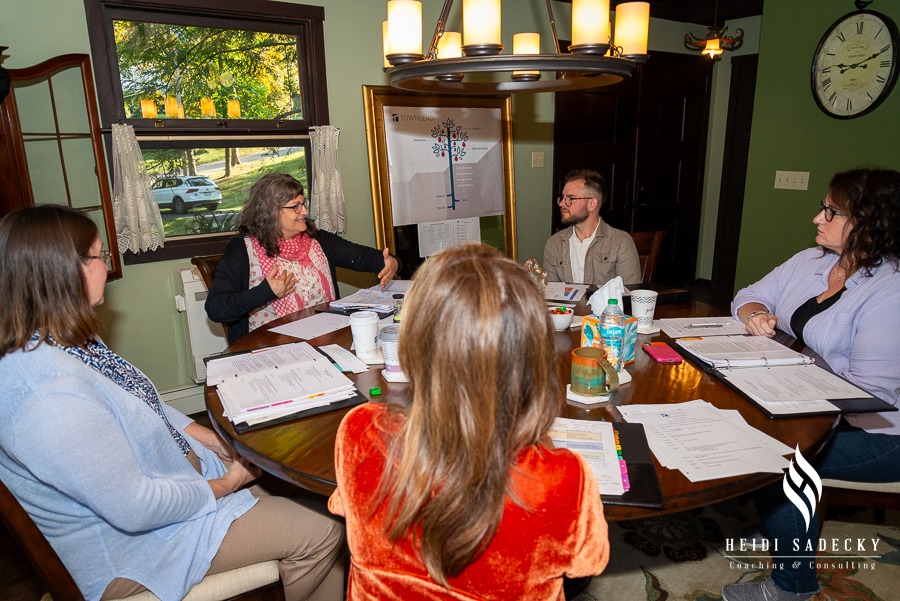
- Peer-based growth: if you’d rather develop alongside hand-picked leaders, the Townsend Leadership Program runs a year, and E4 is the four-month version.
Coaching is the right tool when what’s missing isn’t a skill, but clarity. It works with one leader at a time, but the effect doesn’t stay with one person. Gallup’s 2026 State of the Global Workplace report found that lower manager engagement accounts for most of the recent drop in employee engagement worldwide, with manager engagement falling from 27% to 22% in a single year. When even one leader gets sharper and stronger, the whole team feels it.
Coaching also isn’t advice. Mentors are great resources, and plenty of people retire from a strong career and start offering “here’s what I’d do if I were you.” That can be helpful, but it’s not coaching, and it leaves a leader waiting on another conversation to know how to act.
Real coaching asks questions that lead a leader to their own answer, and builds a framework they can use on an ongoing basis, not just in one scenario.
Keep in mind that there can be trade-offs. SHRM notes that one-on-one coaching can cost more than other development methods and that some leaders see it as remedial. It isn’t, but it does take real investment. The leaders who get the most from it treat the time between sessions as the work, and they act on what comes up. If you’ve been running on survival mode lately, I wrote about why it’s time to call a coach.
Sometimes the Answer Is Both
Training and coaching aren’t an “either/or” situation. They work on different layers of the same team. Training gives teams a shared language and shared skills. Coaching gives leaders the clarity to leverage their expertise and skills, and the tools to set the tone.
Think of it like a bouquet. One gorgeous bloom surrounded by wilted stems doesn’t make a good arrangement, no matter how stunning that one flower is. That’s the leader who’s grown tremendously while the team around them is still stuck in old patterns. But a bouquet of fresh greenery and perfectly good filler is just as flat when the roses and peonies, the ones everyone’s supposed to look at, are dead. That’s the team that learned to communicate beautifully, with no one at the top doing their own work, so the culture snaps right back. The best bouquets work because every part is alive.
Choose training when the friction is between people. Choose coaching when the challenge sits with one leader. Choose both when you’re seeing signs from each list.
Not sure which one you need or where to start? That’s where I come in. Let’s talk through what’s going on and I can tell you what I honestly think will help when you book a discovery call. Know that there are no expectations when we sit down on a call together. No pressure. No obligation. Just a conversation between two professionals.